
A Bagel Deep Dive
How to make incredible NY style bagels

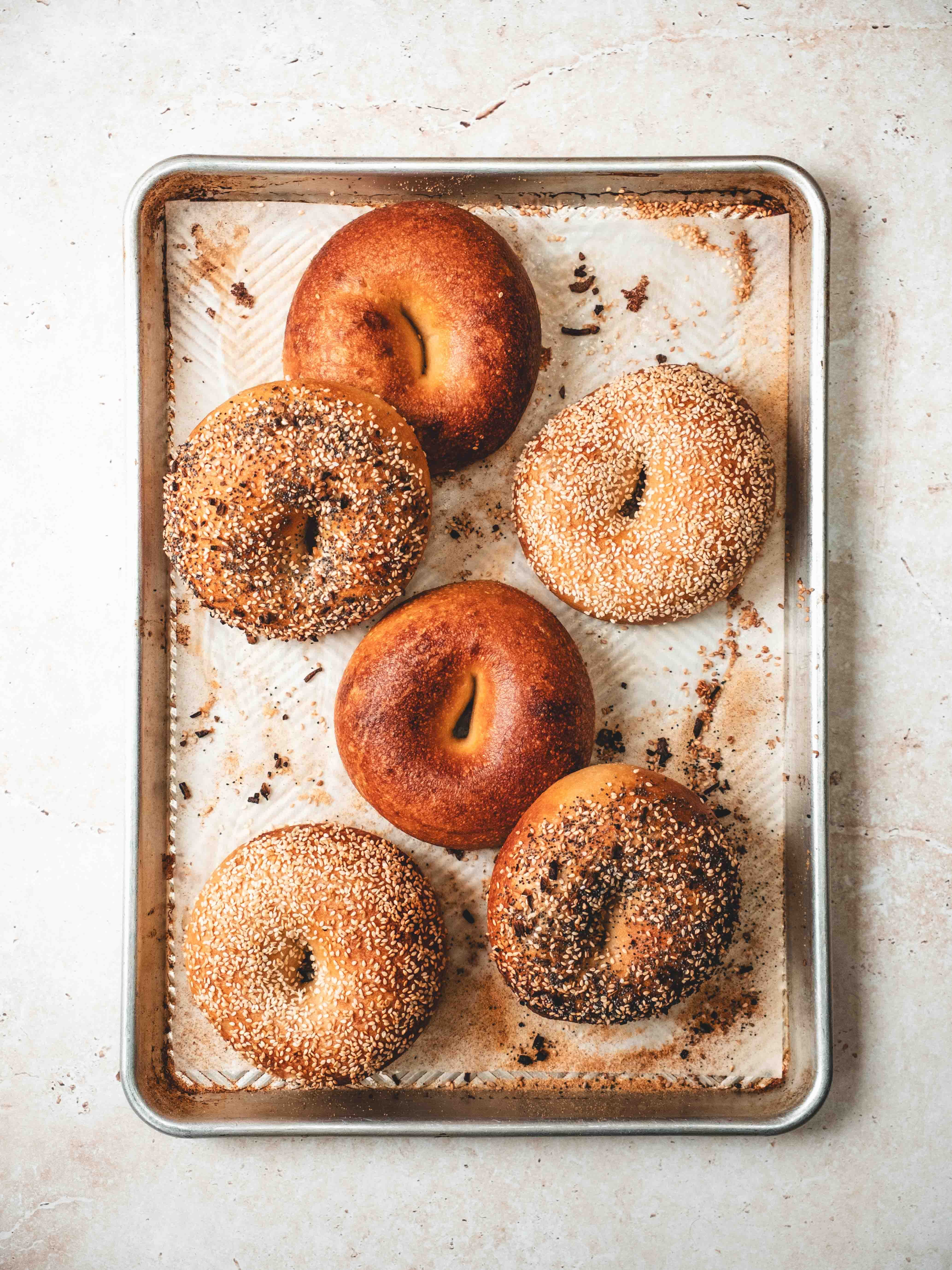
🎉 Welcome to my newsletter, The Boy Who Bakes, a subscriber-supported newsletter dedicated to all things baked. For more bonus posts, filled with exclusive recipes just like this one, you can become a paid subscriber for the weekly newsletter, Second Helpings. It costs just £5 a month and, as well as the weekly recipes, it also unlocks access to the full archive of past recipes. To subscribe to either the paid or free newsletter, click the link below.🎉
Hello! Happy Friday!
This week has been a really fun one. I was back home in Yorkshire, spending a couple of days in the kitchen and studio with Get Baked, finalising the recipe for my upcoming collaboration with them. Very soon you’ll be able to get the Chocolate and Whipped Caramel cake from my book Chocolate Baking, delivered to your door anywhere in the UK! I can't announce the date this will go live just yet, but just know it’s coming sooner than you think!
Talking of Chocolate Baking, don’t forget that for a very limited time you can get the book on Kindle for only £/$1.99! This promotion is running for much longer so make sure to get it whilst its’s this cheap!
London Bagels
Considering this week's post is a deep dive into making NY-style bagels, it is safe to say they are definitely a personal favourite. Growing up, the bagels I would eat were those terribly dry packaged bagels that you can get in any UK supermarket. Tasting a real bagel for the first time made me realise how much those packaged bagels paled in comparison. The flavour and texture were all wrong. Happily, I have visited NYC many times over the years and have had more than my fair share of the real deal. Thankfully, you don’t have to travel across an ocean to get a good bagel these days; London is in the middle of a bagel boom.
London does, of course, have a bagel tradition all of its own; for as long as London has been home to Jewish immigrants, many of whom came to London in the mid-19th century as refugees fleeing persecution, there have been bagels, or should I say beigels. If you’ve ever spent any time in Spitalfields, it becomes plainly obvious that the area was once home to a large Jewish population. Over the years, these communities moved farther north in the city, but they left the bagel shops behind. These bagels are different from their New York counterparts. Generally, they’re more fluffy, a bit more bready, and they’re also almost always plain- no toppings. I have a soft spot for this style, but it’s the New York style that I fell in love with.
London’s current bagel fascination is definitely trying to replicate the bagels found stateside; these new upstart shops are often founded by displaced New Yorkers looking for a taste of home. You’ve got Paulie’s Bagels and Papo’s in the east, It’s Bagels in Soho, Primrose Hill and Notting Hill and a little more recently Banook Bagels in East Dulwich. I really like all of these spots, but if you pressed me I would probably argue that Banook make the most New York of these London bagels.
What Makes A NY style bagel?
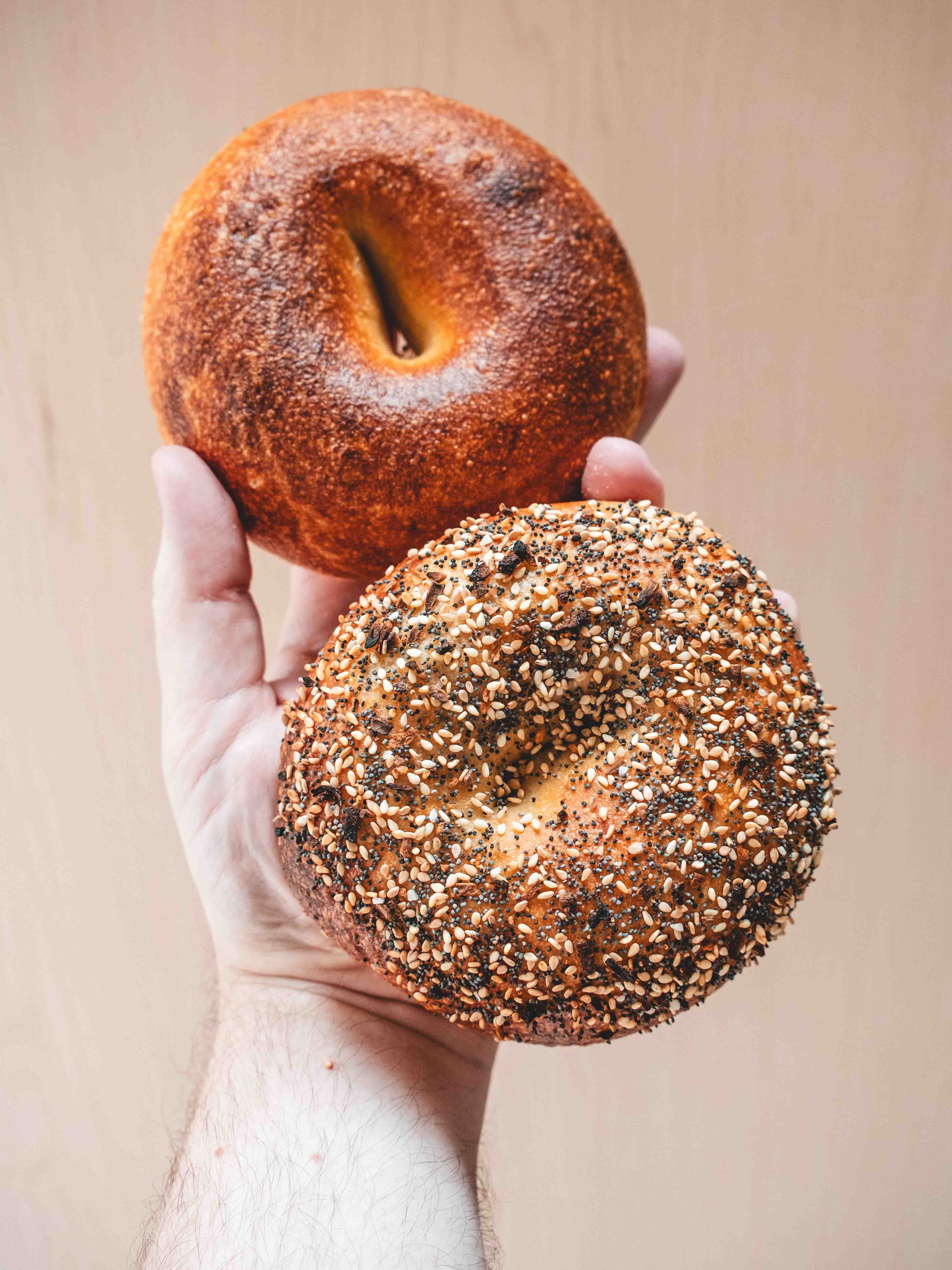
So what actually makes an NY-style bagel? I would argue that it is a hand-rolled product that is slow/cold-fermented and boiled in a malted water bath. The finished product is chewy on the outside with a slightly dense but soft interior. A New York bagel is ALWAYS boiled and made with a stiff, low-hydration dough.
That is traditional bagels, at least. New York is also home to its own upstarts, modern bagel shops that are doing things differently, taking a modern approach. Places like Apollo Bagels make a sourdough bagel with a higher-hydration dough, resulting in a more open texture. They're definitely not NY style bagels, but they are excellent in their own way.
How are they formed
Shaping bagels is arguably one of the most contentious steps. Most online recipes will have you poke a hole in the centre of a ball of dough, which is then opened to make a classic bagel shape. Heck, even I have included this in only versions of my recipe. It is, however, not the traditional technique that makes a bagel a bagel. Traditionally, the dough would be cut into strips and hand-rolled into the bagel shape. If you’ve never seen the art and skill of a New York bagel roller, then watch the clip below. I know at least one of the modern London bagel shops actually flew one of these skilled bagel rollers out to London to teach their bakers to properly shape their rings of dough.
As you can see, the rollers work with a huge mound of dough, and with incredible speed they form ropes of dough that are speedily transformed into bagels. Through this process, tension develops in the dough, which contributes to the finished look and texture of the bagels, so in my recipe I have tried to replicate it.
How To Make A Bagel
Making a NY-style bagel starts with a relatively low-hydration dough. I use a dough made with 55% hydration. To make a strong dough that gives the bagel a nice chew, I use a high-protein flour with about 15% protein. To add flavour and a hint of sweetness, I add a little malt extract, a thick sticky syrup. It is this syrup that, to me, gives bagels their distinctive flavour. You can use dried yeast, but I prefer to hunt down some fresh compressed baker's yeast, as it gives the dough a slightly more yeasty flavour.
Diastatic Malt Powder
You’ll notice that my recipe includes one ingredient you may not have heard of before; don’t worry, it is optional. Diastatic malt powder is a flour made from sprouted barley grains. It is rich with the enzyme amylase, which, when added in very small amounts, aids fermentation and increases browning. Adding a little of this powder to bagels can aid the oven spring when they enter the hot oven, resulting in a slightly lighter finished product. As NY bagels are often thought of as a denser style bread, this can be left out entirely, but I do like the result it gives the finished bagels. The reason this ingredient is in my formula at all is the differences between US and UK flours. Much of the commercially produced bread flour, like the flours used in bagel shops, available in the US is enriched much in the same way UK flour is, but with one difference: most American flour is ‘malted’ and includes the same enzymes found in the diastatic malt powder. This is not the case in the UK, so adding a little of the powder is how I replicate those American flours. Whilst you won't find this powder in any supermarkets, it is really easy to get online; I buy it from Bakery Bits, but you can also just get it on Amazon.
Desired Dough Temperature (DDT)
Because we are going to ferment these bagels for at least 24 hours, it is VERY important that we control the dough's temperature. If the temperature climbs too high, the shaped bagels can overproof in the fridge, resulting in them collapsing whilst they’re being boiled. Ideally, when you’ve finished kneading the dough, it will be sat at around 24-25ºC. To achieve this, we can control the water temperature using a simple bit of arithmetic.
Water Temperature = (DDT x3) - (room temperature + flour temperature + friction factor)
Simply put, to determine the required water temperature, you need the room temperature, the flour temperature, and the friction factor. The latter is how much the dough's temperature will rise due to the physical action of kneading. Kneading by hand is generally considered to increase the temperature by around 4-8ºC, and in a stand mixer the dough increases by around 10-11ºC. The problem with this number is that it can vary significantly depending on how long the dough is kneaded, its hydration level, and even the mixer brand. Ideally, you would make a batch of dough, measure the temperature once a shaggy mass has been formed and then check it again once fully kneaded. This would give you a more accurate number to use in the future. Using the above as a guide, this is what I did when making multiple batches of bagels over the last couple of weeks.
Water Temperature = (DDT 24x3=72) - (room temp 23 + flour temp 22 + friction factor 11 = 56)
Water Temperature = 72 - 56 = 17
This resulted in me using water that is cool, at 17ºC
Boiling the Bagels
Over the years, I have made bagels in a few ways and have tried boiling them with various additions. I have used just a little malt extract, malt extract and baking soda and even malt extract and ‘baked baking soda’, a supercharged version of the base powder. In the end, I have gone back to the most traditional and simple: a little malt extract. This malt adds a little extra flavour and colour to the crust. The most important result of the boiling process is that the outside of the dough gelatinises, giving the bagels their characteristic chewy crust.
Keep reading with a 7-day free trial
Subscribe to The Boy Who Bakes to keep reading this post and get 7 days of free access to the full post archives.